Anthropic has released Claude Sonnet 5 (June 30, 2026), a new model built for agentic AI — autonomous tool use, planning, and browser and terminal control. Anthropic says it closes much of the performance gap with its flagship Opus 4.8 while costing significantly less, and improves meaningfully over Sonnet 4.6 across reasoning, tool use, coding, and knowledge work.
Built for agents
Sonnet 5 is positioned as Anthropic's model for autonomous, multi-step work: calling tools, planning across steps, and operating a browser or terminal. It targets the workloads where agents make many calls and need dependable tool use, not just single-turn answers.
- Autonomous tool use, planning, and browser/terminal control
- Stronger reasoning and coding vs Sonnet 4.6
- Approaches Opus 4.8 quality at a lower price point
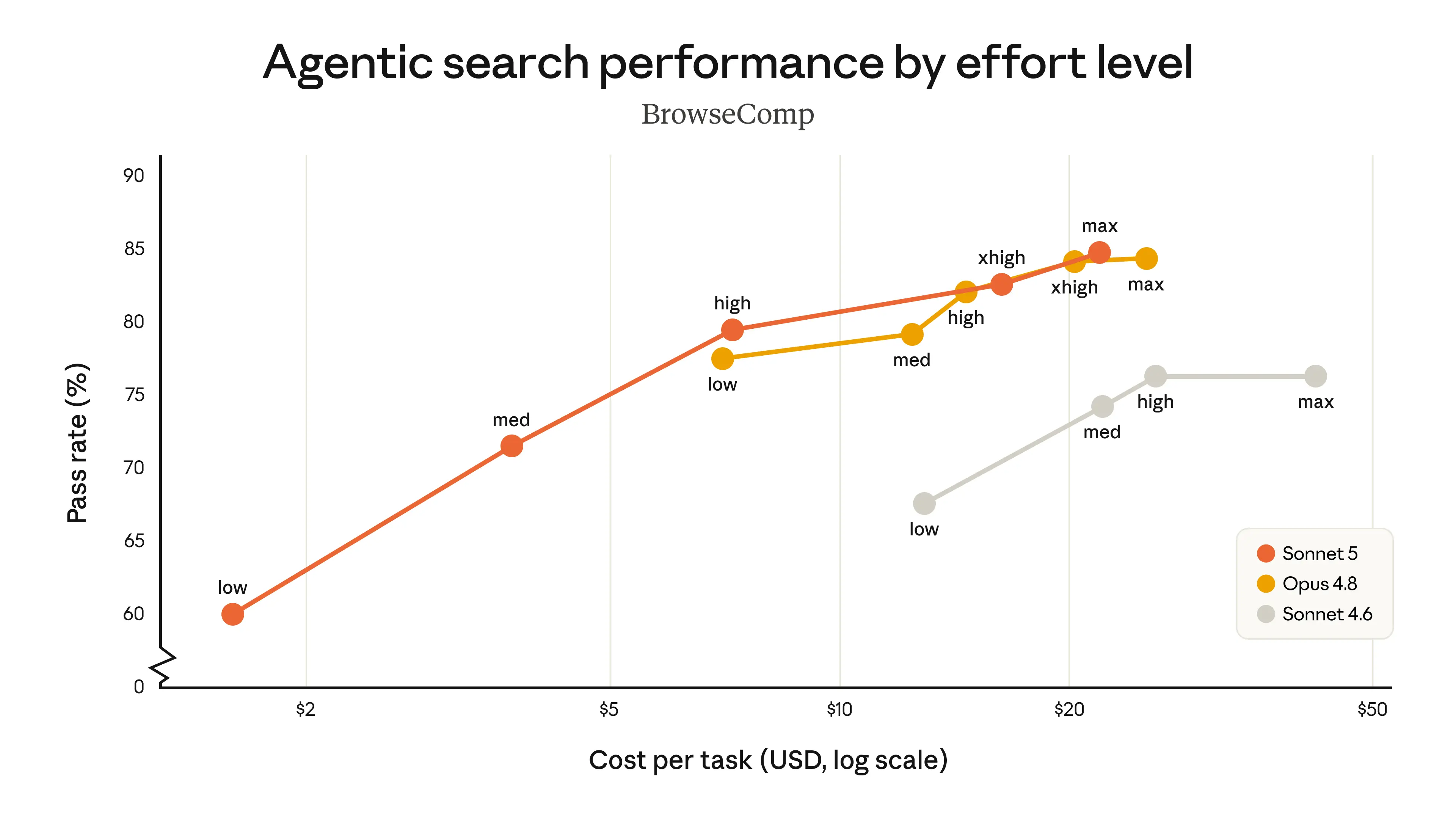
- More cost-efficient at medium "effort" levels
Performance
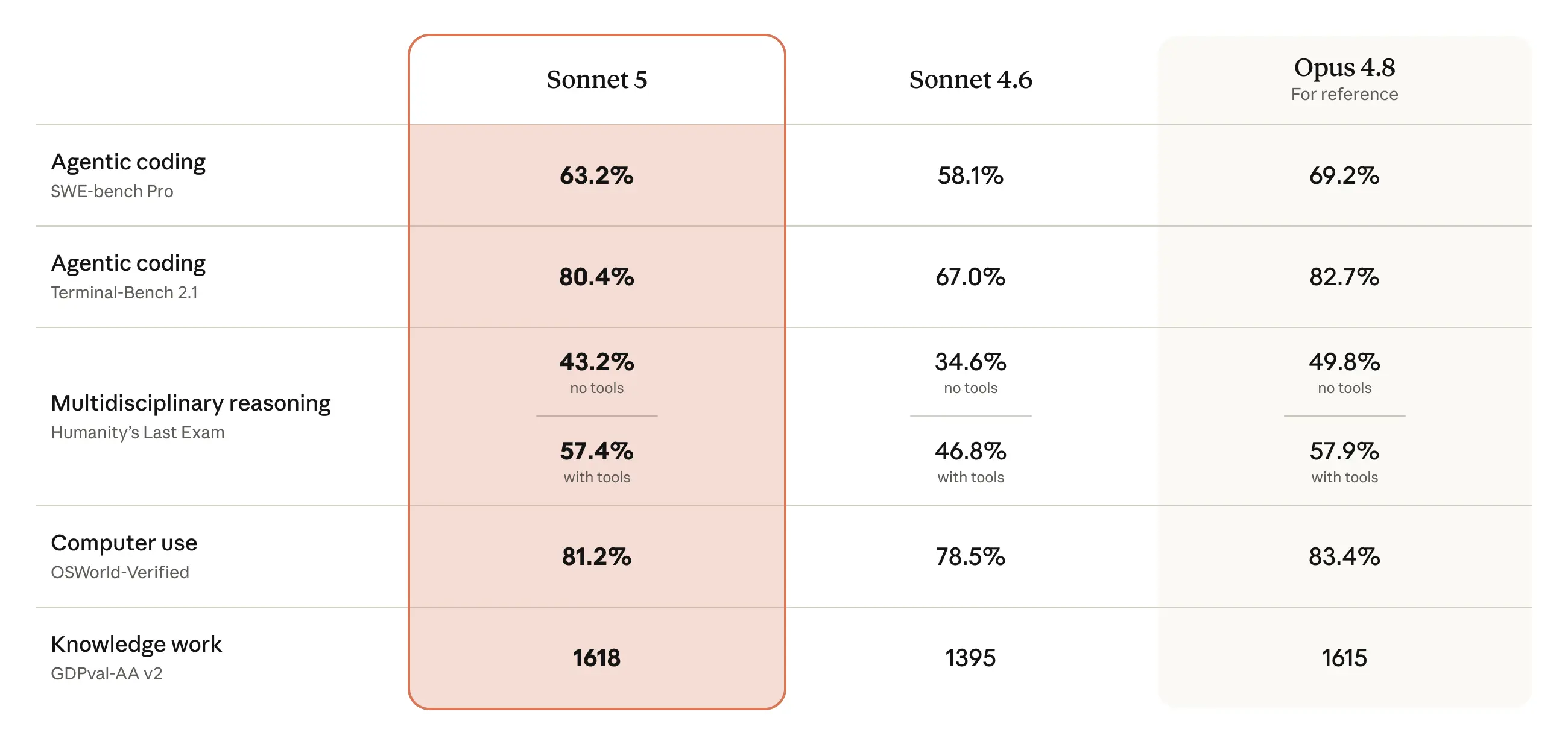
Anthropic reports that Sonnet 5 approaches Opus 4.8 capability levels while remaining a Sonnet-tier (lower-cost) model, and shows substantial gains over Sonnet 4.6. On the OSWorld-Verified computer-use evaluation, Anthropic says it reaches some Opus 4.8 capability levels — a notable step for an agent-oriented model.
Pricing
Sonnet 5 launches with introductory pricing through August 31, 2026, before moving to standard rates.
| Pricing tier | Input (per M tokens) | Output (per M tokens) |
|---|---|---|
| Introductory (through Aug 31, 2026) | $2 | $10 |
| Standard (after) | $3 | $15 |
Availability
Claude Sonnet 5 (model ID: claude-sonnet-5) is available across all plans — it's the default model for Free and Pro, and available to Max, Team, and Enterprise users. Developers can use it through the Claude API, Claude Code, and the Claude Platform.
Safety
Anthropic reports a lower rate of misaligned behavior than Sonnet 4.6. On cybersecurity, the model performs substantially below the Opus line — in a Firefox vulnerability test it had a 0% success rate developing full exploits — and cyber safeguards are enabled by default.
Positioning: Sonnet 5 is the cost-efficient workhorse for agents and everyday tasks; Opus 4.8 remains the more capable option for the hardest problems.
What is the model ID for Claude Sonnet 5?
claude-sonnet-5.
How much does it cost?
Introductory pricing is $2 per million input tokens and $10 per million output tokens through Aug 31, 2026; standard pricing is $3 input / $15 output thereafter.
Where can I use it?
Across all plans — default for Free and Pro, plus Max, Team, and Enterprise — and via the Claude API, Claude Code, and the Claude Platform.
How does it compare to Opus 4.8?
It approaches Opus 4.8 on several evaluations at a lower cost, while Opus 4.8 remains stronger on the most demanding tasks.
Evaluating Sonnet 5 for agents or cost-efficient workloads?
Talk to VanceIQ