A neural network is a computational system loosely inspired by how neurons in the human brain communicate with one another. At its core, it is a mathematical structure that learns to recognize patterns in data by adjusting internal parameters through repeated exposure to examples. Instead of being explicitly programmed with rules, a neural network learns rules from data itself — which is why it sits at the heart of nearly every modern breakthrough in artificial intelligence, from image recognition to chatbots to autonomous vehicles.
This guide breaks down exactly how neural networks work, the different architectures used today, how they are trained, where they are applied in the real world, and what recent research tells us about where this technology is heading. Whether you are a developer, a product manager, or simply curious about the technology behind today's AI tools, this article will give you a solid, practical understanding.
The Building Blocks of a Neural Network
Before diving into how neural networks learn, it helps to understand the basic components that make one up. Every neural network, regardless of how complex, is built from the same fundamental pieces: neurons, weights, biases, and activation functions, all organized into layers.
Neurons: The Basic Processing Units
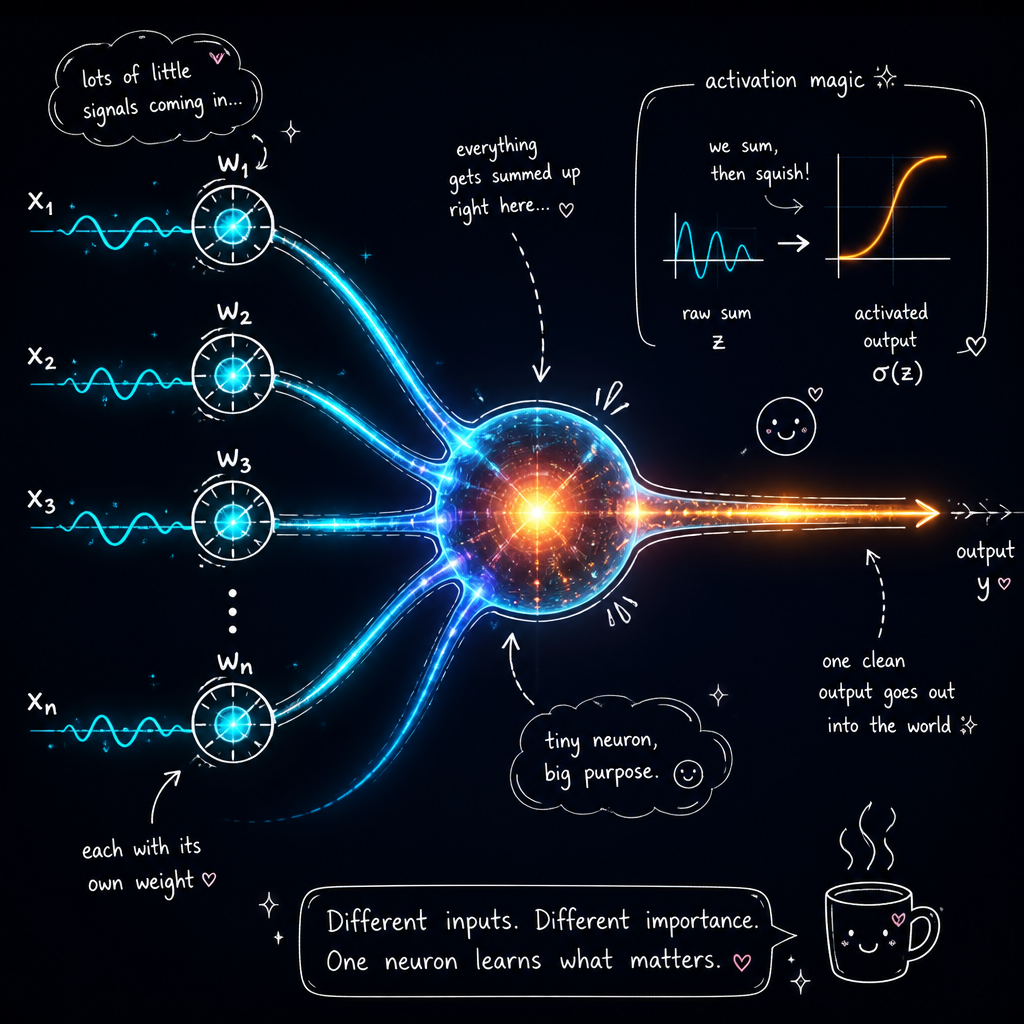
A neuron (sometimes called a node or unit) is a small computational function. It receives one or more numeric inputs, multiplies each input by a weight, adds a bias term, and passes the result through an activation function. The output of that activation function becomes the neuron's signal, which is passed on to the next layer of neurons.
In isolation, a single neuron cannot do much. But when thousands or millions of neurons are connected together in layers, the network as a whole becomes capable of representing extremely complex relationships between inputs and outputs.
Weights and Biases: What the Network Actually Learns
Weights determine how much influence one neuron's output has on the next neuron. Biases shift the output of a neuron up or down independently of its inputs. When people say a neural network is "learning," what they really mean is that the network is adjusting the numeric values of its weights and biases so that its predictions get closer to the correct answer over time.
A large modern neural network can have anywhere from a few thousand to hundreds of billions of these adjustable parameters. Every one of them starts out as a small random number and is refined during training.
Activation Functions: Adding Non-Linearity
If neurons only multiplied inputs by weights and added them up, a neural network would just be a glorified linear equation, no matter how many layers it had. Activation functions solve this by introducing non-linearity, which allows the network to model curves, thresholds, and complex decision boundaries rather than straight lines.
Common activation functions include:
ReLU (Rectified Linear Unit): outputs the input directly if it is positive, otherwise outputs zero. It is fast to compute and widely used in hidden layers.
Sigmoid: squashes values into a range between 0 and 1, often used in output layers for binary classification.
Softmax: converts a set of numbers into probabilities that sum to 1, commonly used for multi-class classification outputs.
Tanh: similar to sigmoid but ranges from -1 to 1, historically used in recurrent networks.
How a Neural Network Is Structured
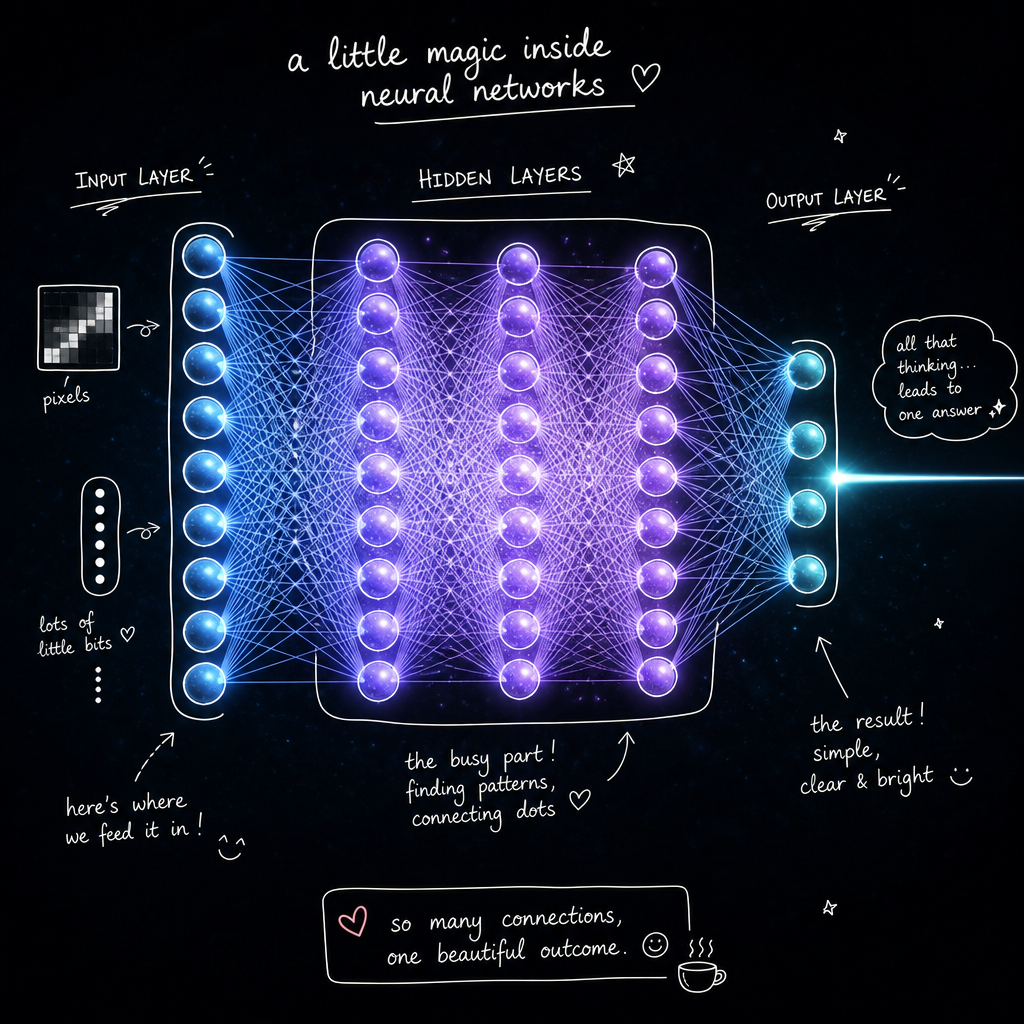
Neural networks are organized into layers, and understanding this layered structure is the fastest way to understand how information flows through the system.
INPUT LAYER        HIDDEN LAYER(S)         OUTPUT LAYER

  (x1) o ----\   /----> o ----\   /----> o
              \ /              \ /
  (x2) o ----> X --------------> X ------> o (prediction)
              / \              / \
  (x3) o ----/   \----> o ----/   \----> o

Each line = a weighted connection
Each 'o'  = a neuron with an activation function
Signal flows left to right (forward propagation)
Errors flow right to left during training (backpropagation)
Input Layer
The input layer receives raw data. For an image, this might be individual pixel values. For text, it might be numeric representations of words or sub-words. For a spreadsheet of customer data, it could be columns like age, income, and purchase history. The input layer does not perform any learning itself; it simply passes standardized data into the network.
Hidden Layers
Hidden layers sit between the input and output layers and are where most of the actual computation happens. Each hidden layer transforms the data it receives into a slightly more abstract representation. In an image classifier, for example, early hidden layers might detect edges and simple shapes, middle layers might detect textures and parts of objects, and later layers might detect entire objects like a face or a car.
A network with many hidden layers is often referred to as a "deep" neural network — this is where the term deep learning comes from.
Output Layer
The output layer produces the network's final answer. Depending on the task, this could be a single number (like a predicted house price), a probability distribution over categories (like "cat," "dog," or "bird"), or a sequence of tokens (like a translated sentence).
How Neural Networks Learn: Training in Practice
Training is the process of exposing a neural network to data and gradually correcting its mistakes. It happens in a repeating cycle of two main steps: forward propagation and backpropagation.
Step 1: Forward Propagation
During forward propagation, input data moves through the network layer by layer. Each neuron applies its weights, bias, and activation function, and passes its output to the next layer, until the output layer produces a prediction.
Step 2: Calculating the Loss
The network's prediction is compared against the correct, known answer using a loss function (also called a cost function). The loss function produces a single number representing how wrong the prediction was. A high loss means the network performed poorly; a low loss means it performed well.
Step 3: Backpropagation and Gradient Descent
Backpropagation is the algorithm that calculates how much each individual weight in the network contributed to the error. It works backward from the output layer to the input layer, using calculus (specifically the chain rule) to assign "blame" to each weight.
Once the contribution of each weight to the error is known, an optimization algorithm called gradient descent nudges each weight in the direction that reduces the error. This process repeats — often millions of times — across many examples, gradually shrinking the loss and improving accuracy.
Simple analogy: think of training a neural network like adjusting hundreds of dials on a mixing board to get a song to sound right. You play the song (forward propagation), listen for what's off (loss), and turn each dial slightly in the direction that improves the sound (backpropagation and gradient descent). Repeat thousands of times and the mix gets better and better.
Types of Neural Networks and What They're Used For
Not all neural networks are built the same way. Different architectures are optimized for different kinds of data. Choosing the right architecture is one of the most important decisions when building an AI system.
Convolutional Neural Networks (CNNs)
Convolutional Neural Networks are designed to process grid-like data such as images. Instead of connecting every neuron to every pixel, CNNs use small filters (also called kernels) that slide across the image and detect local patterns like edges, corners, and textures. Stacking multiple convolutional layers allows the network to build up from simple features to complex object recognition.
CNNs power facial recognition systems, medical image analysis, quality-control cameras on factory lines, and self-driving car vision systems.
Recurrent Neural Networks (RNNs)
Recurrent Neural Networks are built for sequential data, where the order of information matters — things like speech, time series, or sentences. RNNs include feedback loops that allow information from previous steps to influence the processing of the current step, giving the network a form of memory.
Traditional RNNs struggle with very long sequences because early information tends to fade out, a problem addressed by variants like LSTM (Long Short-Term Memory) and GRU (Gated Recurrent Unit) networks, which use gating mechanisms to preserve important information over longer stretches.
Transformers
Transformers are a more recent architecture that has largely replaced RNNs for many sequence-based tasks, especially in natural language processing. Rather than processing data one step at a time, transformers use a mechanism called self-attention, which allows the model to weigh the importance of every part of the input relative to every other part simultaneously. This makes transformers far more efficient to train in parallel and better at capturing long-range relationships in text.
Transformers are the architecture behind today's large language models, powering everything from chatbots to code assistants to machine translation tools.
| Architecture | Best suited for | Key mechanism | Example applications |
|---|---|---|---|
| CNN | Images, video, spatial data | Convolutional filters | Facial recognition, medical imaging, defect detection |
| RNN / LSTM | Sequential or time-based data | Feedback loops, memory gates | Speech recognition, older translation systems, forecasting |
| Transformer | Language and long sequences | Self-attention | Chatbots, machine translation, code generation, search |
| Feedforward (basic) | Structured/tabular data | Simple layer-to-layer connections | Credit scoring, basic prediction tasks |
A Worked Example: Training a Neural Network to Recognize Handwritten Digits
To make the training process concrete, let's walk through a classic example: teaching a neural network to recognize handwritten digits from 0 to 9, similar to the well-known MNIST dataset used widely in machine learning education.
- Collect and prepare data: gather thousands of labeled images of handwritten digits, each 28x28 pixels, with the correct digit (0-9) attached as a label.
- Design the network: build an input layer of 784 neurons (one per pixel), one or two hidden layers of a few hundred neurons each, and an output layer of 10 neurons (one per digit) using a softmax activation.
- Initialize weights randomly: before training, the network's predictions are essentially random guesses.
- Run forward propagation: feed an image through the network and get a predicted probability for each of the 10 digits.
- Calculate the loss: compare the predicted probabilities to the true label using a loss function such as cross-entropy loss.
- Run backpropagation: calculate how much each weight contributed to the error.
- Update the weights: apply gradient descent to nudge weights in the direction that reduces the loss.
- Repeat across the full dataset for multiple passes, called epochs, until accuracy on a held-out validation set stops improving.
- Test on new, unseen digit images to confirm the network generalizes well rather than simply memorizing the training data.
After a few epochs of training on a dataset like this, a modestly sized neural network can typically reach well above 97% accuracy on recognizing handwritten digits it has never seen before. This same basic workflow — collect data, design architecture, train, validate, test — applies to nearly every neural network project, whether it's classifying images, predicting sales, or generating text.
Neural Networks vs. Traditional Programming and Classical Machine Learning
A common point of confusion is how neural networks differ from traditional software and from simpler machine learning models like decision trees or linear regression. The table below highlights the key differences.
| Approach | How it works | Strengths | Limitations |
|---|---|---|---|
| Traditional programming | Explicit if-then rules written by developers | Transparent, predictable, easy to debug | Cannot handle unstructured data like images or free-form text well |
| Classical machine learning (e.g., decision trees, linear regression) | Learns patterns from structured, tabular data using statistical methods | Fast to train, interpretable, works well on smaller datasets | Struggles with raw images, audio, or complex language |
| Neural networks | Learns hierarchical patterns from large amounts of raw or structured data | Excels at images, audio, and language; scales well with more data | Requires large datasets and compute; less interpretable ("black box") |
Real-World Applications of Neural Networks
Neural networks are no longer confined to research labs. They power tools and services that many people interact with every day.
- Computer vision: facial recognition on smartphones, automated quality inspection in factories, and object detection in security cameras.
- Natural language processing: chatbots, virtual assistants, grammar checkers, and document summarization tools.
- Speech recognition: voice-to-text transcription, voice assistants, and real-time translation earpieces.
- Healthcare diagnostics: analyzing medical scans to flag abnormalities, including recent systems that detect brain bleeding from CT scans faster than manual review.
- Forecasting: predicting demand, energy usage, weather patterns, and financial market trends.
- Autonomous vehicles: interpreting camera and sensor data in real time to detect lanes, pedestrians, and obstacles.
- Recommendation systems: suggesting products, videos, or music based on learned user preferences.
- Fraud detection: identifying unusual transaction patterns in banking and e-commerce systems.
What's New in Neural Network Research
Neural network research continues to move quickly, with new architectures, hardware, and applications appearing regularly. A few recent developments illustrate how broad this field has become:
- Physics-guided neural networks are being combined with uncertainty modeling to improve spatiotemporal wind speed prediction, blending scientific domain knowledge with learned patterns.
- Researchers are developing wafer-scalable artificial synapses and organic transistor-based logic circuits aimed at building hardware that mimics neural processing for artificial vision.
- Convolutional neural networks are being applied to consumer-grade wearable device data to predict ground reaction forces, opening new possibilities for sports science and injury prevention.
- Neural networks are being used to make large-scale quantum simulations more computationally efficient, a promising direction for physics and materials research.
- AI systems analyzing CT imaging in real time have been shown to detect brain bleeding faster than manual review in clinical settings, highlighting neural networks' growing role in emergency diagnostics.
- New energy-efficient chip designs, including collaborations focused on in-memory computing, aim to make neural network inference more practical on edge devices with limited power budgets.
- Large language model releases continue to push the boundaries of what transformer-based neural networks can do, with newer model families offering tiered options for reasoning depth versus response speed.
The pace of neural network research means today's cutting-edge architecture can be tomorrow's baseline. Staying current on fundamentals, however, remains the best way to evaluate and adopt new tools as they emerge.
Challenges and Limitations of Neural Networks

Despite their power, neural networks are not a magic solution for every problem. Understanding their limitations is essential for using them responsibly and effectively.
Data Requirements
Neural networks generally need large amounts of labeled or structured data to perform well. Small datasets often lead to overfitting, where the network memorizes training examples instead of learning generalizable patterns.
Computational Cost
Training large neural networks, especially deep architectures with billions of parameters, requires significant computing power, often specialized hardware like GPUs or dedicated AI accelerators. This translates directly into energy and infrastructure costs.
Interpretability
Neural networks are often described as "black boxes" because it can be difficult to explain exactly why a network made a specific prediction. This is a genuine concern in high-stakes fields like healthcare, finance, and law, where explainability and accountability matter as much as accuracy.
Bias and Fairness
A neural network learns whatever patterns exist in its training data, including unwanted biases. If the training data reflects historical inequities, the network can reproduce or even amplify them. Careful data curation, testing, and ongoing monitoring are necessary to reduce this risk.
How to Get Started with Neural Networks
If you're looking to build practical skills or evaluate whether a neural network approach fits your project, here's a sensible path forward.
- Start with the fundamentals: understand linear algebra basics (vectors, matrices), probability, and how gradient descent works before jumping into frameworks.
- Pick a beginner-friendly framework such as TensorFlow/Keras or PyTorch, both of which have extensive documentation and community support.
- Practice on well-known datasets such as MNIST (digits), CIFAR-10 (images), or public tabular datasets to build intuition without worrying about data collection.
- Learn to evaluate models properly using training, validation, and test splits, and understand metrics beyond simple accuracy, such as precision, recall, and F1 score.
- Experiment with pre-trained models before training from scratch; transfer learning can save enormous amounts of time and data.
- Once comfortable with the basics, explore specialized architectures relevant to your goals, such as CNNs for vision or transformers for language.
- Always validate that your model generalizes to real-world data rather than just performing well on the training set.
If you're evaluating whether your business problem is a good fit for a neural network, ask three questions first: do you have enough quality data, is the pattern too complex for simpler statistical models, and can you tolerate a model that is harder to fully explain? If the answer to all three is yes, a neural network approach is likely worth exploring.
Frequently Asked Questions About Neural Networks
What is a neural network in simple terms?
A neural network is a computer system made of interconnected layers of simple processing units, called neurons, that learns to recognize patterns in data by adjusting the strength of connections between neurons based on examples, rather than following explicitly programmed rules.
How is a neural network different from artificial intelligence in general?
Artificial intelligence is the broad field of building systems that perform tasks requiring human-like intelligence. A neural network is one specific technique within AI and machine learning, and it currently underlies most state-of-the-art AI systems, but AI also includes other approaches like rule-based systems and search algorithms.
Do neural networks actually work like the human brain?
Only loosely. Neural networks are inspired by biological neurons and synapses, but they are simplified mathematical models. Real brains are vastly more complex, energy-efficient, and adaptable than any artificial neural network built to date.
How much data does a neural network need to train well?
It depends on the task and architecture, but generally more is better. Simple tasks on structured data might work with a few thousand examples, while complex tasks like image or language modeling often require millions of examples, though techniques like transfer learning can significantly reduce this requirement.
What is the difference between deep learning and neural networks?
Deep learning refers to the use of neural networks with many hidden layers (a deep architecture). All deep learning involves neural networks, but not every neural network is deep; a network with only one or two hidden layers is still a neural network, just not typically called deep learning.
Can neural networks explain why they made a specific decision?
Not easily. Neural networks are often described as black boxes because their decisions emerge from millions of numeric weight adjustments rather than explicit logical rules. Techniques such as attention visualization and feature attribution methods can offer partial insight, but full transparency remains an active area of research.
Are transformers a type of neural network?
Yes. Transformers are a specific neural network architecture that uses a self-attention mechanism to process sequences of data, such as text. They have become the dominant architecture for language-based tasks and power most modern large language models.
References
- Physics-guided neural network for spatiotemporal wind speed prediction with uncertainty evolution
- Wafer-scalable artificial synapses based on coplanar self-aligned-gate organic transistors
- Convolutional neural network prediction of ground reaction force using wearable devices
- Neural networks unlocking larger quantum simulations at lower computational cost
- AI system detecting brain bleeding from CT imaging in real time
Curious how a neural network could solve a real problem in your business? Let's talk through your data and goals.
Get in touch