On July 9, 2026, OpenAI made GPT-5.6 generally available across ChatGPT, ChatGPT Work, Codex, and the API, with a global rollout completing over 24 hours. It arrived two weeks late by OpenAI's own standards — the family spent its first stretch in a limited preview with the US government approving access customer by customer, a saga we unpacked in our piece on why model access is becoming political. Now that anyone can use it, the more interesting questions are practical ones: what do the three tiers actually offer, what do they cost, what's genuinely new for developers, and where does each one fit in an enterprise stack? Here's our review.
From gated preview to general availability
GPT-5.6 was announced on June 26 as a limited preview restricted to government-approved partners while Washington and OpenAI negotiated a framework for frontier releases. The wider release came after the Department of Commerce's Center for AI Standards and Innovation ran additional testing on the models and cleared broader availability. That sequence — preview, government evaluation, then GA — is worth noting on its own: it may be the template for how frontier models launch from now on. But with the gate now open, GPT-5.6 is available to everyone, everywhere the API operates.
Meet the family: Sol, Terra, and Luna
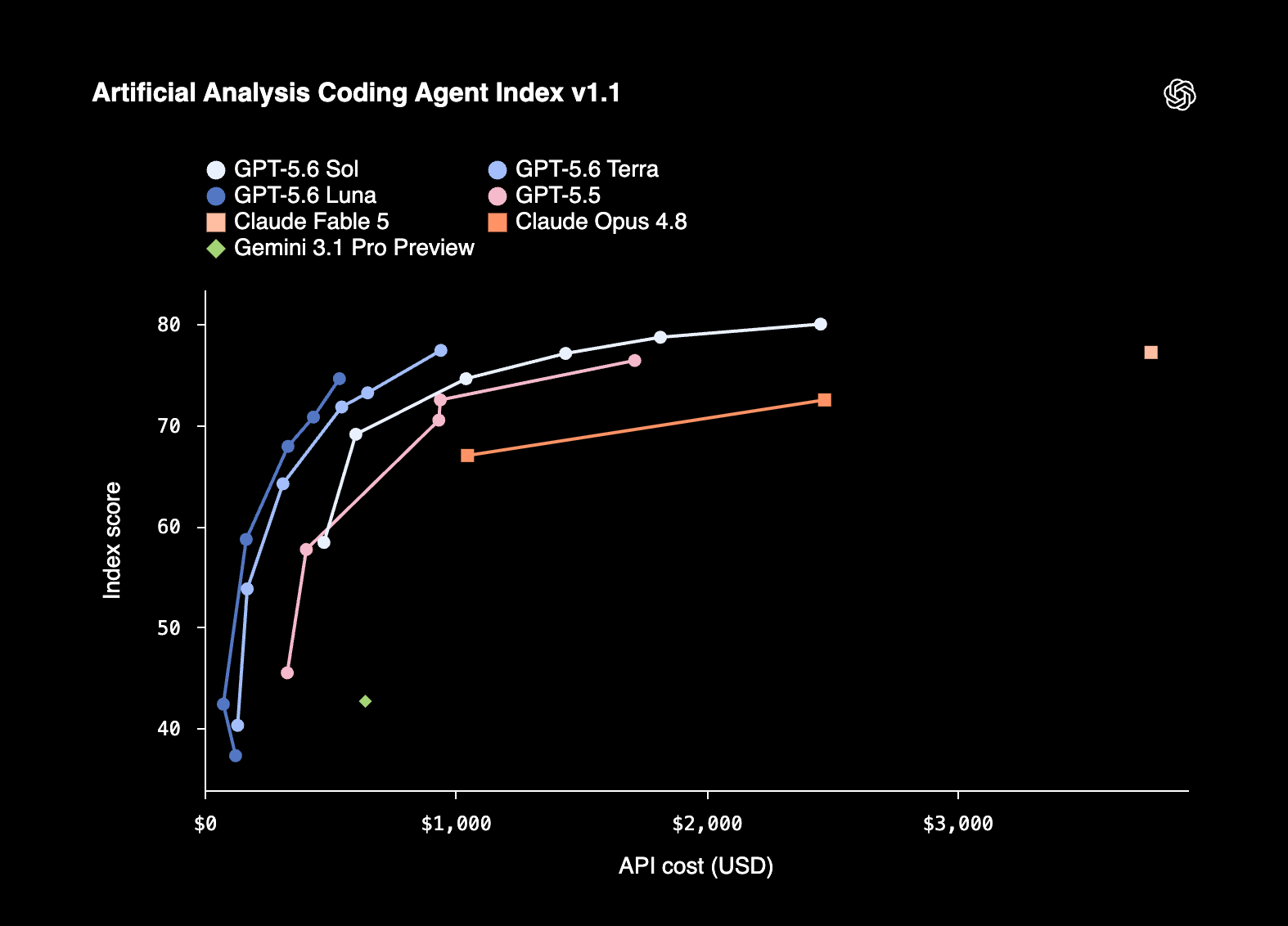
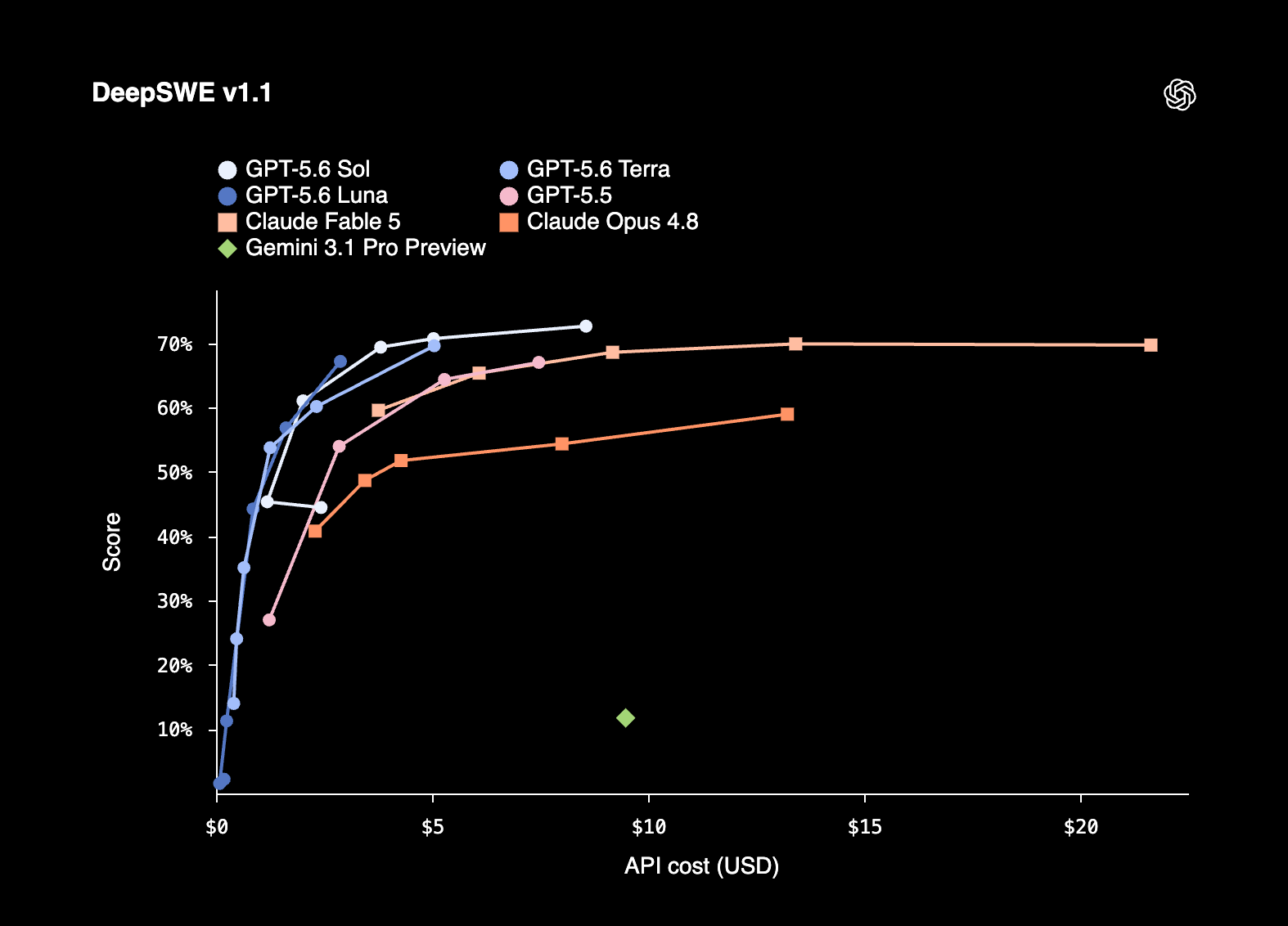
GPT-5.6 is not one model but three, and the naming scheme is deliberate: the number marks the generation, while Sol, Terra, and Luna are durable capability tiers that can advance on their own cadence. Sol is the flagship — the strongest reasoning, coding, long-horizon planning, and agentic performance, with particular tuning for biology, chemistry, and cybersecurity work. Terra is the balanced everyday workhorse: OpenAI positions it at roughly GPT-5.5-level performance at half the price. Luna is the speed-and-economics tier, built for classification, extraction, routing, and short replies where latency and unit cost dominate.
| Tier | Positioning | API price per 1M tokens (input / output) |
|---|---|---|
| Sol | Flagship — deepest reasoning, agentic coding, long-horizon planning | $5 / $30 |
| Terra | Balanced workhorse — ~GPT-5.5-class performance at roughly half the cost | $2.50 / $15 |
| Luna | Fastest and cheapest — classification, extraction, routing, high-volume tasks | $1 / $6 |
- All three tiers share a 1 million token context window
- Maximum output is 128,000 tokens across the family
- Knowledge cutoff is February 16, 2026 for all three models
- In the API, the models are addressed as gpt-5.6-sol (or the gpt-5.6 alias), with Terra and Luna variants alongside
Benchmarks: where Sol stands
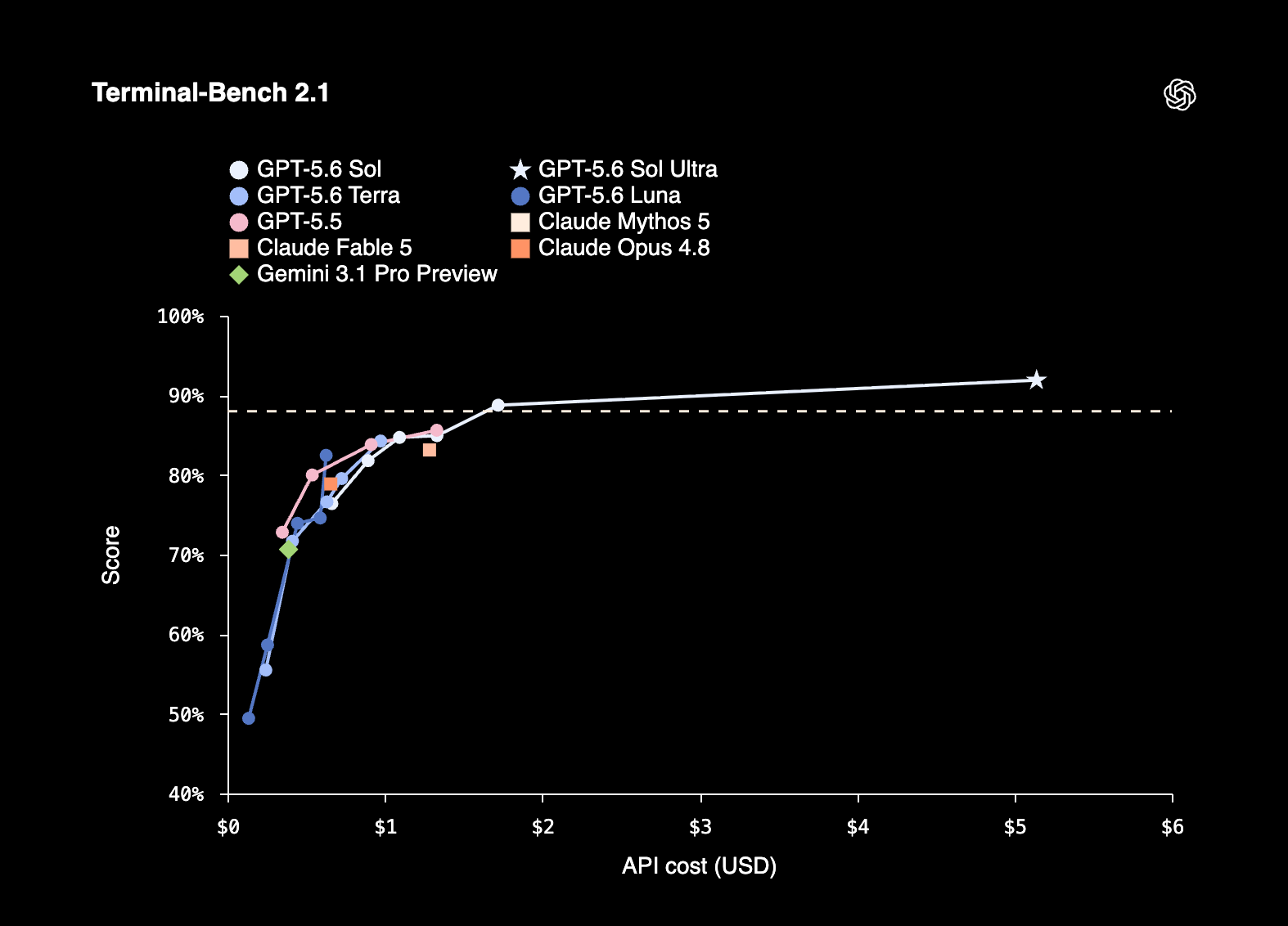
The headline benchmark this cycle is Terminal-Bench 2.1, which tests real command-line workflows requiring planning, iteration, and tool coordination — a reasonable proxy for agentic coding. OpenAI reports a new state of the art for Sol, with the parallel-compute Sol Ultra mode ahead of every published frontier score:
| Model | Terminal-Bench 2.1 |
|---|---|
| GPT-5.6 Sol Ultra | 91.9% |
| GPT-5.6 Sol | 88.8% |
| Claude Mythos 5 | 88.0% |
| GPT-5.6 Terra | 84.3% |
| Claude Fable 5 | 84.3% |
| GPT-5.6 Luna | 82.5% |
| Claude Opus 4.8 | 78.9% |
The usual caveat applies: these are vendor-published numbers on a single benchmark. The detail worth noticing is the middle of the table — Terra ties Claude Fable 5 at 84.3% while costing $2.50/$15 per million tokens. The frontier story is Sol, but the price-performance story is Terra.
What's new for developers
The GA also shipped a new Responses API surface, and the standout is Programmatic Tool Calling. Instead of the classic loop — model calls a tool, waits, reads the result, calls the next tool — GPT-5.6 can write JavaScript that orchestrates a whole tool sequence inside an isolated V8 sandbox (no network access), processing intermediate results in memory and returning only the final output. OpenAI cites token reductions of 38% to 63.5% from named early customers on multi-step workflows, since intermediate results never round-trip through the model's context.
- Programmatic Tool Calling — model-written orchestration code in a sandboxed V8 runtime, compatible with zero-data-retention setups
- Reasoning effort now spans none, low, medium, high, xhigh, and max
- New reasoning modes 'pro' and 'ultra' — ultra coordinates four agents in parallel by default, trading token spend for stronger results on hard tasks
- Persisted reasoning across turns and explicit prompt-caching breakpoints for finer cost control
curl https://api.openai.com/v1/responses \
  -H "Authorization: Bearer $OPENAI_API_KEY" \
  -H "Content-Type: application/json" \
  -d '{
    "model": "gpt-5.6-sol",
    "reasoning": { "effort": "high" },
    "input": "Summarize the attached incident logs and draft a postmortem outline."
  }'
Where you'll see it: ChatGPT, Codex, and Copilot
- ChatGPT: Plus, Pro, Business, and Enterprise users get Sol at medium and higher effort settings; Pro and Enterprise can also select Sol Pro
- Codex: Ultra mode is available from the Plus plan upward
- ChatGPT Work: Ultra is reserved for Pro and Enterprise users
- GitHub Copilot: Sol, Terra, and Luna landed in Copilot on launch day
What this means for enterprise teams
Our practical read, tier by tier. If you run agentic coding or complex multi-step workflows, Sol is the one to evaluate — and Programmatic Tool Calling may matter more than the benchmark delta, because a 38–63% token reduction on orchestration-heavy workloads changes the economics of agent pipelines, not just their quality. If you have production workloads on a mid-tier model today, Terra is the value pick to test first: frontier-adjacent scores at mid-tier pricing. And if you run high-volume, low-complexity tasks — routing, extraction, classification — Luna's $1/$6 pricing makes it the default candidate.
Two process reminders apply regardless of tier. First, don't switch on benchmarks — re-run your own evaluation suite against the new models before moving any production traffic; vendor numbers are a shortlist, not a verdict. Second, this release is also a reminder of the lesson from its own delayed launch: GPT-5.6 reached GA only after government testing, on a timeline OpenAI didn't fully control. Adopt the new tiers where they win on your evals — and keep the model-contingency playbook in place while you do.
What is GPT-5.6 and when was it released?
GPT-5.6 is OpenAI's frontier model family, released to general availability on July 9, 2026 across ChatGPT, ChatGPT Work, Codex, and the API. It comes in three tiers: Sol (flagship), Terra (balanced), and Luna (fast and low-cost).
How much does GPT-5.6 cost in the API?
Per 1 million tokens (input/output): Sol is $5/$30, Terra is $2.50/$15, and Luna is $1/$6. All three tiers share a 1M-token context window and a 128K maximum output.
Is GPT-5.6 Sol better than Claude's frontier models?
On OpenAI's published Terminal-Bench 2.1 results, Sol (88.8%) and Sol Ultra (91.9%) edge out Claude Mythos 5 (88.0%), while Terra ties Claude Fable 5 at 84.3%. Those are vendor numbers on one benchmark — run your own evaluations before drawing conclusions for your workload.
Which GPT-5.6 tier should my team use?
As a starting point: Sol for agentic coding and complex reasoning, Terra for balanced production workloads where cost matters, and Luna for high-volume tasks like classification, extraction, and routing. Validate the choice against your own evaluation suite.
Deciding where GPT-5.6 fits in your product — or whether it should?
Talk to VanceIQReferences
- GPT-5.6: Frontier intelligence that scales with your ambition — OpenAI
- Previewing GPT-5.6 Sol — OpenAI
- OpenAI to publicly release GPT-5.6, ending government limits — CNBC
- OpenAI gets permission to roll out GPT-5.6 to the public on July 9 — Engadget
- The new GPT-5.6 family: Luna, Terra, Sol — Simon Willison
- GPT-5.6 with Programmatic Tool Calling in the Responses API — MarkTechPost
- GPT-5.6 Sol, Terra, and Luna available in GitHub Copilot — GitHub Changelog
- GPT-5.6 buzz builds: what to know about OpenAI's new Sol model — Axios